
So that we don’t have to run a power cable as far to get to the observatory (cable is expensive!), I decided to tap into our existing power infrastructure at the inverters for our solar panels, which are somewhat on the way from our main service at the house. That saves about 150 feet of cable that I wouldn’t have to run. Nevertheless, there was still around 350 feet of additional power cable to run from the solar panels to the observatory, making for about 500 feet of distance in total from our service at the house to the observatory. The reason I wanted to run service from our house rather than have a separate service and transformer at the observatory, is that having a separate service would require an additional monthly expense from the power company.
This is a significant distance to cover for an electrical cable, with the concern being that voltage drop increases as the current increases. To minimize voltage drop, I elected to use a heavy 3/0 gauge cable with a service maximum of 60 amps. This is a significantly larger cable than is normally used for 60 amp service – typically, #6 cable is sufficient for 60 amp runs within a house, as is typical in running power to an oven. In fact, the cross sectional area of 3/0 gauge cable is about 8 times larger than #6 gauge cable. This will help to prevent the voltage at the end of the cable from dropping significantly if there is a high current draw at the observatory, though most of the devices that will be installed there are not high current devices.
The specific cable used is designated as 3/0 AWG 3C ACWU90. If you’re curious as to what the numbers all mean, 3/0 is the gauge (diameter) of each conductor, 3C designates that it has 3 conductors (the two live phases and a neutral, plus a ground that isn’t in the designation), and ACWU90 is the type of cable (armored cable, wet/underground locations, 90°C temperature rating).
We got the spool of cable from Eecol in Edmonton, and the thing weighed probably close to 1000 pounds – enough that I was a bit concerned that it might be too heavy for our little trailer. But we did get it home. Getting it off the trailer was another adventure – I unspooled about half of it onto the ground loop by loop, and then I was able to get an engine hoist under it to lift the rest of the spool out.
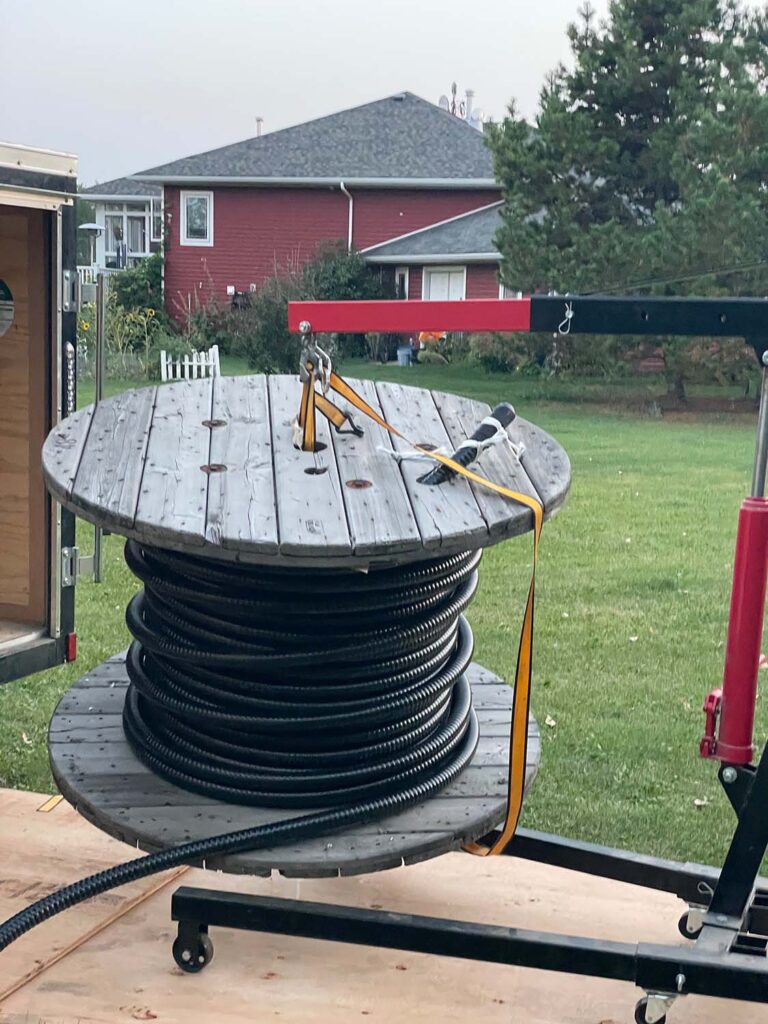
Here, the cable is being laid roughly where it is going to be routed from the solar panels.
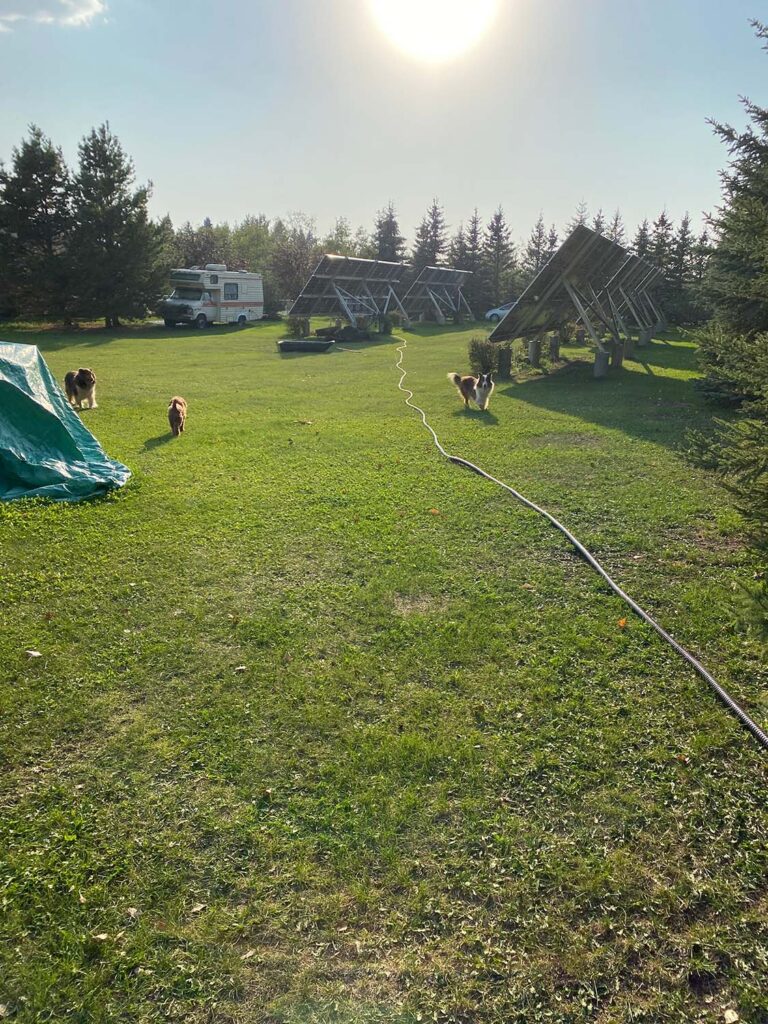
And then further, along our fence line before eventually going under the fence and the rest of the way to the observatory.

We rented a Ditch Witch from TPH rentals in Westlock for the day, and made big use of it. We trenched out the route from our solar panels in the yard to the observatory, including a trench connecting to our house, to route a fibre optic cable from the house to the observatory.

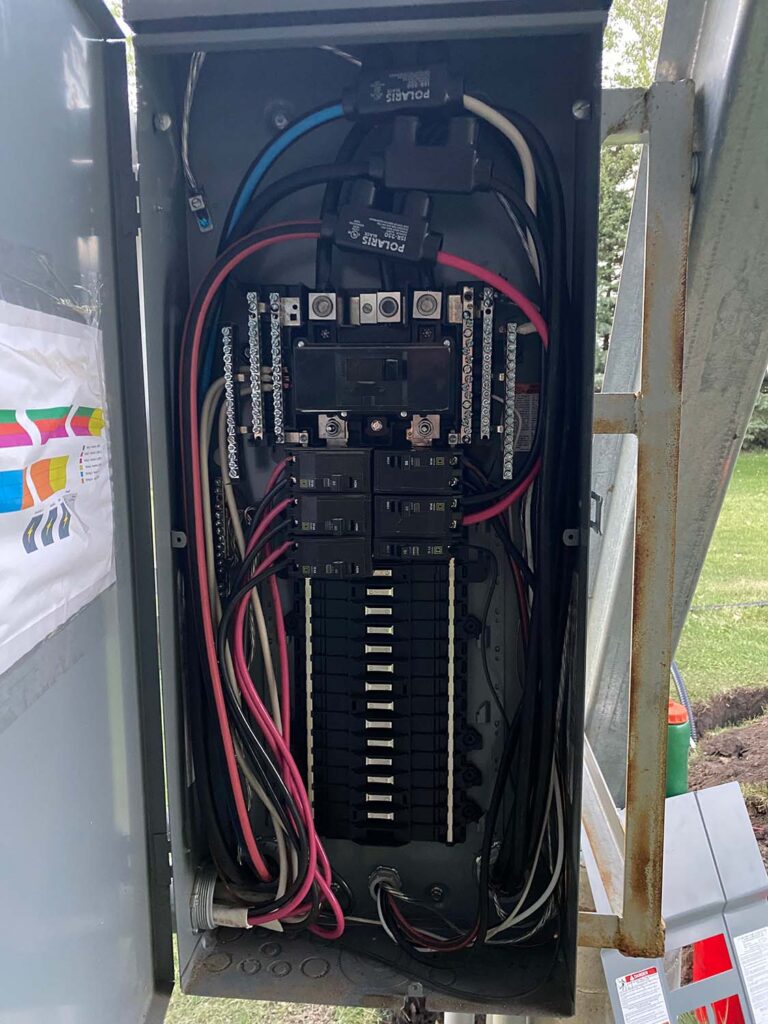
Here is the inside of the electrical panel at our solar panels. The 3 Polaris connectors near the top are necessary because the large 3/0 gauge wire running to the observatory is much too thick of a cable to connect to a 60 amp breaker. So the Polaris connectors allow us to “splice” that heavy cable to #4 gauge cable that can be connected to the 60 amp breaker directly.
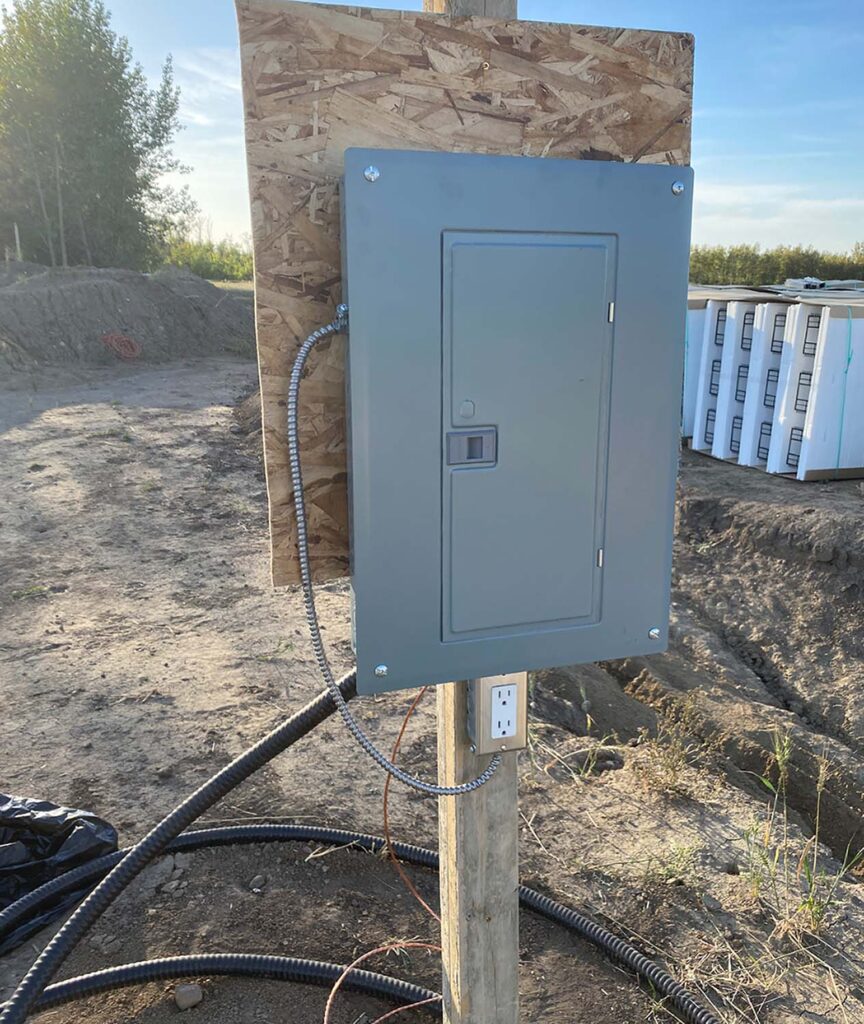
Here is where the cable ends up when it gets to the observatory. On the side are ICF forms that were recently delivered that will be used for the cement frost wall of the foundation.

With the electrical cable laid out and connected at our solar panels, I was able to set up a temporary service at the observatory so we didn’t have to run the generator any more when we needed power there. The panel will eventually find its way inside the observatory when the building is framed.
In the trench, I buried the power cable at the bottom, covered it with around a foot of dirt, then laid our fibre optic cable on top of that, another layer of dirt, then some 2x4s for mechanical protection near the observatory, and then caution tape before finishing covering it all up. The 2x4s were used to help prevent the fibre optic cable from being damaged with the heavy equipment that would be driving back and forth over the trench as the observatory was being built. Within 50 feet of the observatory, the fibre optic cable is also protected inside a 1″ PVC conduit, particularly because the end will be relocated a fair bit throughout construction.
The fibre optic cable laid between the house and observatory is a 200 metre length of LC to LC UPC Outdoor Armored, 9/125µm single mode duplex cable. I have 10 gigabit SFP+ transceivers at both ends, and it is working great. So long as it doesn’t get damaged between now and when the observatory construction is finished, I will have 10 gigabit connectivity to the observatory.

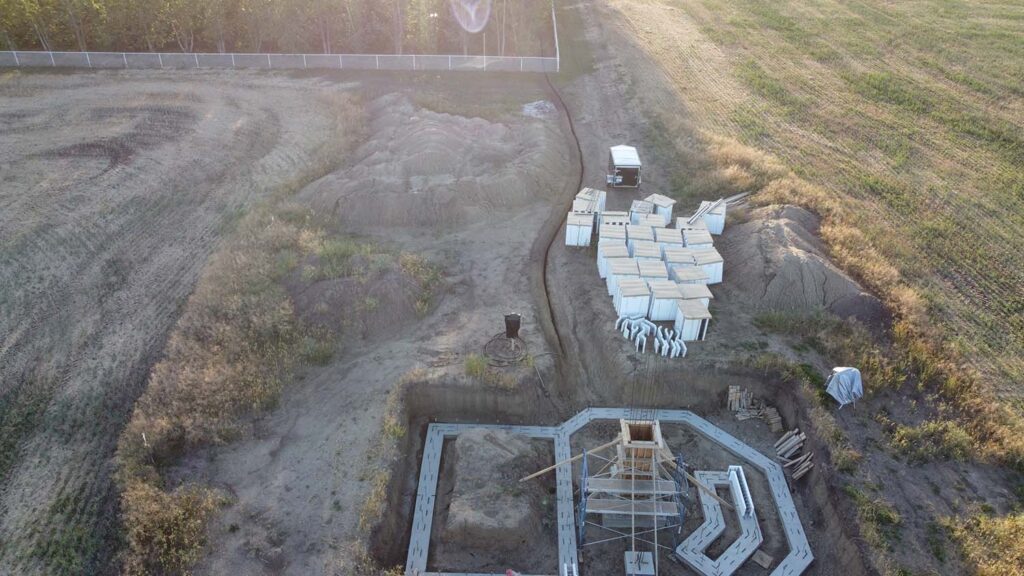
Here is a drone shot showing the cable trench towards our residence.
And finally, here is a mosaic of several drone shots showing the routing of the trench and cables from the observatory to our electrical connection at the solar panels, and data connection to our house.
